
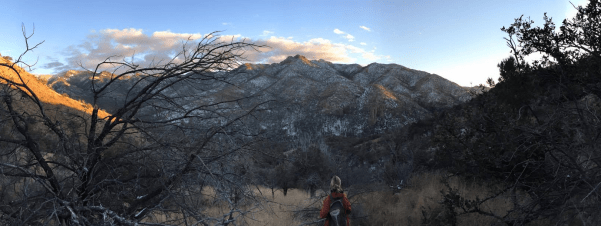
If you sit and listen to the sound of rain falling in the desert, if you listen real closely, you will hear the gift of life pouring forth, and the earth swallowing deep. You will hear water dripping from branches, gamble quail and mourning dove splashing in puddles—trilling with delight, chasing one another in playful circles—and the Canyon Wren’s long, drawn out, soporific laughter. A layer of clouds nestles into the foothills of the Sky Island mountains, muffling all thoughts of harsh, decomposed granite, thorny brush, or predators lurking. And the desperate hunt and scramble for survival is momentarily forgotten.
This is the sound of a winter rain in the desert. A sustaining, gentle, necessary season of rain that comes tastefully, with a bottle of wine and a homemade dessert, to your dinner party. You smile, with great nostalgia and fond memory, and let the rain in. This is the chilly rain that washes the desert world clean and frosts the mountain tops all the way down to the low lying foothills. This is not a desert monsoon. But it is a very important and integral season of rain that the desert requires to survive.
The monsoon season of 2012 was the opposite of a desert winter’s rain. It blew in with chaos, cumulus nimbus clouds building black and statuesque, thousands of feet into the troposphere, envying the staggering, next-level layer of stratosphere, vying to touch the closest realms of outer space with wispy fingers, velvet palms. The storms built quick and powerful, and as the air cooled toward the tops of cloud anvils, they collapsed upon themselves, sending downdrafts of chilled air to kick up sand into your sun-glazed eyes.
The monsoon was violent and savage, and we liked it this way. It fit perfectly into the harsh landscape of desert summer. It really couldn’t happen any other way, the reprieve from hell on earth. An embodiment of what storms would be like had Satan commanded them himself. The monsoon.
That summer I was volunteering at the animal shelter. I’d quit fighting fires, wildland, and maybe this time for good, I thought. It wore me down and the pressure seemed to be making me sick—my body instructing my brain that it was time to be done. The nerves and muscles that connect to the stomach destroyed my inner anatomical landscape, and the stress of it all made me chronically ill in the wilderness—tool in hand, gear piled high, emergency response always a breath away, and I was hanging tight to a tree somewhere, pale and weak. The opposite of how I’d adventured in the job for years. I should probably listen to these subtle hints, I thought.

So if I couldn’t steward the land with wildfire, I would help by working with wildlife. But I was in the city of Tucson, so I thought I would help the domestic animals that ran wild there. I took home my first foster dog (a commitment I will come back to later), and volunteered to walk dogs at the giant county shelter overflowing with cages of abandoned canines. On my first day, I went with my mentor and we walked dogs for 6 hours, there were that many. The sound inside the giant chamber was deafening, so we used hand signals to communicate with one another—to decide which dog to get next, or which door to take them out, or how many dogs were still left to walk. Once we had put the last dog back, I attempted to ask where the water fountain was, but I opened my mouth and a sob came out instead. I was exhausted, my nerves shot—once again—and I had no words. I never knew this place existed, like this. And that all the discarded animals would be so good. So undiscardable. So genuine and eager to love.
The room had quieted some, since there was a much needed expenditure of energy, so you could hear my tears—more like a rush of winter rain that balanced out the summer’s violence. My mentor hugged me and she said, “I know. It’s pretty awful.” And now we both knew. I knew and I could never un-know again. Just like a wildfire in the forest, or a severe cyclone in the Caribbean, this problem of abandoned animals was happening—violent and chaotic and human caused. Human presented. Could it be like global warming? Like climate change? A monstrous deposit of unwanted animals—like old asbestos mines, or nuclear byproduct—of throw away dogs whose brains have the same capacity as a human three-year-old—had accumulated in the gutters and collected in the reservoir run-off, so that civilized people, “animal lovers,” didn’t have to look the problem in the giant, beautiful, mixed-breed eyes, and they could make frail, passive comments like, “Oh, I could never volunteer at that place. I couldn’t do it. It’s too sad. I would want to take them all home, and that’s just not possible.” So gather them away to the outskirts of town—like monsoon floodwaters—tumultuous, frothy, filled with energy, needing to run, endless inertia—and pretend the debris has all washed to sea. This is an all too frequent solution to alleviate and unfetter the progress and comfort of civilization. And its bull shit, is what it is.

I heard this line all the time, when I told people I volunteered at the county animal shelter. It confused me. Humans—per usual—did the exact opposite of what their hearts told them to do because the heart couldn’t handle the experience. But how could the heart know about it and do nothing? I quickly learned that chastising people for their self-preservationist approach to a problem would not produce a positive result. You start to hear yourself saying, “Well, I’m sure you do what you can,” which is more bull shit, but a person cannot be forced to see things clearly. Or to see anything at all. They can only see when their hearts are ready, if ever.
As for the human-centric population of the city, it was a non-thing to them. They had the human babies. So stick to your air-conditioning, your 2 kids, your $10,000 Labradoodle, and pretend that your species—you—aren’t to blame for the depository of brilliant, large-brained, highly sentient, emotionally intelligent, and human devoted reservoir of abandon sadness. It’s got to be better. We have to do better than this, I thought.
So once again, I was between jobs. A retired, academic wildland firefighter (a more common occurrence than you might think), and I had lots of time to give. And I was not accustomed to looking the other way once I’d seen a situation that demanded response. Required triage. In wildland fire, you arrive on-scene to a new start, you anchor in at the heel of the fire origin, and you start flanking it—chainsaws, pulaskis, and digging tools. And you wore personal protective gear, like ear plugs. The same kind the animal shelter handed out to interact with the dogs, like they were a loud, violent crisis. The similarities of the two scenarios struck me as uncanny. And unnecessarily tragic. But the parallel was real, as wildfires in the woods could be caused by nature—lightning strikes that lit up the ground and took to the crowns—or they could be caused by humans—abandoned campfires that kicked about in the wind and duff, and found sticks to feed them and leaves to gobble up. Again, the similarities in disasters overwhelmed me.

But there were few people panicking. Nobody was calling 911 to report an emergency. And the few persons that had met the problem, head on, were left to flounder in the shallow pool of resources available to alleviate the suffering. I stared in horror—wide-eyed and teary—at this disaster of a puppy plume that had accumulated, and knew it was time to be part of the action, once again. Sometimes humanity lets me down, and I’ve accepted this. They let me down so low I have to find my head lamp to crawl out of the giant crevice. But I do it. I crawl back again, keeping my head lamp a little closer each time.
So we went outside to talk and I asked my mentor how this had happened, after removing my ear plugs, and she said, “People have babies, people take new jobs, people move, people forget what it means to commit.” And the sound of the word commitment, it struck a chord. I wasn’t raised in a family that took commitment lightly. My parents are still married, both sets of their parents stayed married, and if I took on a hobby, I was required to see it through. And we certainly had never dumped or abandoned our family dog anywhere, let alone at the shelter of horrors. Were we lucky? Maybe. There’s also a little thing called tenacity. Grit. Commitment. You don’t give up on a person, or an animal, once you commit to them, unless the situation is life or death. Then you choose life. But I read about canine brains—because they impressed me more each day—and the developed capacity was identical to that of a three year old human, with a small difference in the region of language development. In particular, Broca’s region. So I wanted to tell the women, these men, these “committed” couples that threw out their one year old dog—that used to be a cuddly puppy but now had become a pre-adolescent handful—because they just had a human baby, or the animal was needing too much time, I wanted to ask them, “so, if your baby isn’t speaking by age three, will you drop her off at the orphanage, too?” Because that is what it’s like. An advanced, large mammalian brain capable of experiencing joy, fear, pain, suffering, and most similarly, trauma from abuse, neglect or abandonment. A brain that is imprinted upon. A brain that remembers. A brain that has complex emotion, and an animal that wants only to belong to a social group. A pack. A domestic, human pack, mostly. And why are they seen as so inferior to human children by these supposed nurturing and loving parents? Because they are soul-less? Do you consider your three year old to be soul-less because their brains are as undeveloped as a border collie’s? Look into their eyes and tell me, an abandoned, feral human baby would be any better than these shelter dogs. The difference is, they wouldn’t survive. These animals will survive, many of them, and it is up to the human population that doesn’t look away, has an inkling of understanding of what the word commitment or integrity means, and knows what it’s like to be let down by the void in human morals. Human ethics, when it is inconvenient, or in the name of civilization and progress.

It is left to the eyes wide open humans to rehabilitate. To rehabilitate these animals in hopes of somehow bringing our human species a little closer to rehabilitating itself. To take responsibility and educate. To heal the sickness and the great divide that has split humanity from animal, nature from urbanity, and health from progress. This wound—like a jagged, black fire scar on the mountainside—is vast, and it’s visible from the sky—the great collections of pain and suffering, of chaos and abandonment. It’s visible from the aerial view of desert birds, storm clouds, and stratospheric jet streams that have been altered by warming temperatures. Yes, we are capable of great destruction. I have seen it in the forest and I have seen it in the cities. But we are also capable of great connection. Capable of communion—with one another and the wild. With animals that need us, just as we need them.
Monsoon season in the desert—with its violent reprieve and tumultuous, yet soothing flood waters—reminds me of this. Reminds me of all capacity, and where humans and nature must co-exist, or risk eternal sickness, suffering, and alienation from the greatest, wildest parts of ourselves. From those we’ve failed to save—through lack of integrity and commitment—ultimately ourselves, and our own mental, physical, emotional, and spiritual health.
So if you sit and listen to the sound of the rain—the sustaining, soft winter rains, or the violent, pounding, summer monsoonal rains, know that your commitment—to nature, to animals, to humans—constitutes who you are and your failure to uphold these commitments contributes to the riff—the great divide—between humanity and its fullest potential, and to the degradation of God’s blessed animal kingdom. You are fighting your true, natural self when you place humans above nature instead of within, and your weakness of innate character causes a domino effect of trauma; a crippling in human happiness. Human-caused or nature-caused, the destructive results are the same. Only one is preventable.
Be committed to rehabilitation, like rainfall in the desert. Rehabilitation of all creatures and landscape. Be like rain. Be like water, for we are nothing without water. And we are nothing without one another.

 Rehabbing Rain
Beautiful, moving piece. Feeling my guilt, inspired to do better.
LikeLiked by 1 person
Haha, hopefully it was more inspiring than shaming, but yes, we can always do better! 😉 Thanks, Rick!
LikeLike
Beautiful, insightful, moving piece. Is this a snapshot from your book?
LikeLiked by 1 person
Thanks, Pam! This is hopefully a collection of essays for a new book, someday! The last book is a little different subject matter. How’s Gymai coming? 🙂
LikeLike
What beautiful, deep, god-filled wisdom. I think you are the canine’s deva this lifetime.
LikeLiked by 1 person
Thank you, Connie! Happy to hear from you. It always means so much! Canine Deva is genius, I like it. 🙂
LikeLike