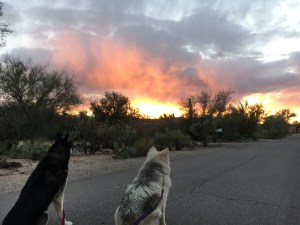
Winter Rains, Summer Showers: the Animal Shelter

If you sit and listen to the sound of rain falling in the desert, if you listen real closely, you will hear the gift of life pouring forth, and the earth swallowing deep. You will hear water dripping from branches, gamble quail and mourning dove splashing in puddles—trilling with delight, chasing one another in playful circles—and the Canyon Wren’s long, drawn out, soporific laughter. A layer of clouds nestles into the foothills of the Sky Island mountains, muffling all thoughts of harsh, decomposed granite, thorny brush, or predators lurking. And the desperate hunt and scramble for survival is momentarily forgotten.

This is the sound of a winter rain in the desert. A sustaining, gentle, necessary season of rain that comes tastefully, with a bottle of wine and a homemade dessert, to your dinner party. You smile, with great nostalgia and fond memory, and let the rain in. This is the chilly rain that washes the desert world clean and frosts the mountain tops all the way down to the low lying foothills. This is not a desert monsoon. But it is a very important and integral season of rain that the desert requires to survive.
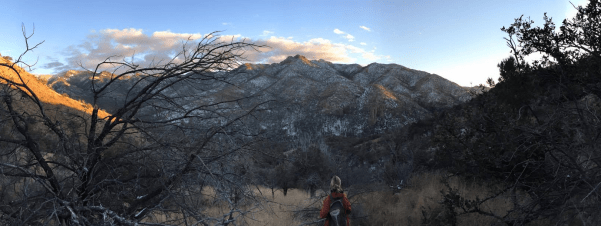
desert mtns w snow and me walking

The monsoon season of 2012 was the opposite of a desert winter’s rain. It blew in with chaos, cumulus nimbus clouds building black and statuesque, thousands of feet into the troposphere, envying the staggering, next-level layer of stratosphere, vying to touch the closest realms of outer space with wispy fingers, velvet palms. The storms built quick and powerful, and as the air cooled toward the tops of cloud anvils, they collapsed upon themselves, sending downdrafts of chilled air to kick up sand into your sun-glazed eyes.

The monsoon was violent and savage, and we liked it this way. It fit perfectly into the harsh landscape of desert summer. It really couldn’t happen any other way, the reprieve from hell on earth. An embodiment of what storms would be like had Satan commanded them himself. The monsoon.

That summer I was volunteering at the animal shelter. I’d quit fighting fires, wildland, and maybe this time for good, I thought. It wore me down and the pressure seemed to be making me sick—my body instructing my brain that it was time to be done. The nerves and muscles that connect to the stomach destroyed my inner anatomical landscape, and the stress of it all made me chronically ill in the wilderness—tool in hand, gear piled high, emergency response always a breath away, and I was hanging tight to a tree somewhere, pale and weak. The opposite of how I’d adventured in the job for years. I should probably listen to these subtle hints, I thought.

night desert fire

So if I couldn’t steward the land with wildfire, I would help by working with wildlife. But I was in the city of Tucson, so I thought I would help the domestic animals that ran wild there. I took home my first foster dog (a commitment I will come back to later), and volunteered to walk dogs at the giant county shelter overflowing with cages of abandoned canines. On my first day, I went with my mentor and we walked dogs for 6 hours, there were that many. The sound inside the giant chamber was deafening, so we used hand signals to communicate with one another—to decide which dog to get next, or which door to take them out, or how many dogs were still left to walk. Once we had put the last dog back, I attempted to ask where the water fountain was, but I opened my mouth and a sob came out instead. I was exhausted, my nerves shot—once again—and I had no words. I never knew this place existed, like this. And that all the discarded animals would be so good. So undiscardable. So genuine and eager to love.

The room had quieted some, since there was a much needed expenditure of energy, so you could hear my tears—more like a rush of winter rain that balanced out the summer’s violence. My mentor hugged me and she said, “I know. It’s pretty awful.” And now we both knew. I knew and I could never un-know again. Just like a wildfire in the forest, or a severe cyclone in the Caribbean, this problem of abandoned animals was happening—violent and chaotic and human caused.  Human presented. Could it be like global warming? Like climate change? A monstrous deposit of unwanted animals—like old asbestos mines, or nuclear byproduct—of throw away dogs whose brains have the same capacity as a human three-year-old—had accumulated in the gutters and collected in the reservoir run-off, so that civilized people, “animal lovers,” didn’t have to look the problem in the giant, beautiful, mixed-breed eyes, and they could make frail, passive comments like, “Oh, I could never volunteer at that place. I couldn’t do it. It’s too sad. I would want to take them all home, and that’s just not possible.” So gather them away to the outskirts of town—like monsoon floodwaters—tumultuous, frothy, filled with energy, needing to run, endless inertia—and pretend the debris has all washed to sea. This is an all too frequent solution to alleviate and unfetter the progress and comfort of civilization.  And its bull shit, is what it is.

flood waters

I heard this line all the time, when I told people I volunteered at the county animal shelter. It confused me. Humans—per usual—did the exact opposite of what their hearts told them to do because the heart couldn’t handle the experience. But how could the heart know about it and do nothing? I quickly learned that chastising people for their self-preservationist approach to a problem would not produce a positive result. You start to hear yourself saying, “Well, I’m sure you do what you can,” which is more bull shit, but a person cannot be forced to see things clearly. Or to see anything at all. They can only see when their hearts are ready, if ever.

As for the human-centric population of the city, it was a non-thing to them.  They had the human babies. So stick to your air-conditioning, your 2 kids, your $10,000 Labradoodle, and pretend that your species—you—aren’t to blame for the depository of brilliant, large-brained, highly sentient, emotionally intelligent, and human devoted  reservoir of abandon sadness. It’s got to be better. We have to do better than this, I thought.

So once again, I was between jobs. A retired, academic wildland firefighter (a more common occurrence than you might think), and I had lots of time to give. And I was not accustomed to looking the other way once I’d seen a situation that demanded response. Required triage. In wildland fire, you arrive on-scene to a new start, you anchor in at the heel of the fire origin, and you start flanking it—chainsaws, pulaskis, and digging tools. And you wore personal protective gear, like ear plugs. The same kind the animal shelter handed out to interact with the dogs, like they were a loud, violent crisis. The similarities of the two scenarios struck me as uncanny. And unnecessarily tragic. But the parallel was real, as wildfires in the woods could be caused by nature—lightning strikes that lit up the ground and took to the crowns—or they could be caused by humans—abandoned campfires that kicked about in the wind and duff, and found sticks to feed them and leaves to gobble up. Again, the similarities in disasters overwhelmed me.

Rain n Crevice

But there were few people panicking. Nobody was calling 911 to report an emergency. And the few persons that had met the problem, head on, were left to flounder in the shallow pool of resources available to alleviate the suffering. I stared in horror—wide-eyed and teary—at this disaster of a puppy plume that had accumulated, and knew it was time to be part of the action, once again. Sometimes humanity lets me down, and I’ve accepted this. They let me down so low I have to find my head lamp to crawl out of the giant crevice. But I do it. I crawl back again, keeping my head lamp a little closer each time.

So we went outside to talk and I asked my mentor how this had happened, after removing my ear plugs, and she said, “People have babies, people take new jobs, people move, people forget what it means to commit.” And the sound of the word commitment, it struck a chord. I wasn’t raised in a family that took commitment lightly. My parents are still married, both sets of their parents stayed married, and if I took on a hobby, I was required to see it through. And we certainly had never dumped or abandoned our family dog anywhere, let alone at the shelter of horrors. Were we lucky? Maybe. There’s also a little thing called tenacity. Grit. Commitment. You don’t give up on a person, or an animal, once you commit to them, unless the situation is life or death. Then you choose life.  But I read about canine brains—because they impressed me more each day—and the developed capacity was identical to that of a three year old human, with a small difference in the region of language development. In particular, Broca’s region. So I wanted to tell the women, these men, these “committed” couples that threw out their one year old dog—that used to be a cuddly puppy but now had become a pre-adolescent handful—because they just had a human baby, or the animal was needing too much time, I wanted to ask them, “so, if your baby isn’t speaking by age three, will you drop her off at the orphanage, too?” Because that is what it’s like. An advanced, large mammalian brain capable of experiencing joy, fear, pain, suffering, and most similarly, trauma from abuse, neglect or abandonment. A brain that is imprinted upon. A brain that remembers. A brain that has complex emotion, and an animal that wants only to belong to a social group. A pack. A domestic, human pack, mostly. And why are they seen as so inferior to human children by these supposed nurturing and loving parents? Because they are soul-less? Do you consider your three year old to be soul-less because their brains are as undeveloped as a border collie’s? Look into their eyes and tell me, an abandoned, feral human baby would be any better than these shelter dogs. The difference is, they wouldn’t survive. These animals will survive, many of them, and it is up to the human population that doesn’t look away, has an inkling of understanding of what the word commitment or integrity means, and knows what it’s like to be let down by the void in human morals. Human ethics, when it is inconvenient, or in the name of civilization and progress.

Rain n Bri holding head in waterfall

It is left to the eyes wide open humans to rehabilitate. To rehabilitate these animals in hopes of somehow bringing our human species a little closer to rehabilitating itself. To take responsibility and educate. To heal the sickness and the great divide that has split humanity from animal, nature from urbanity, and health from progress. This wound—like a jagged, black fire scar on the mountainside—is vast, and it’s visible from the sky—the great collections of pain and suffering, of chaos and abandonment. It’s visible from the aerial view of desert birds, storm clouds, and stratospheric jet streams that have been altered by warming temperatures. Yes, we are capable of great destruction. I have seen it in the forest and I have seen it in the cities. But we are also capable of great connection. Capable of communion—with one another and the wild. With animals that need us, just as we need them.

Monsoon season in the desert—with its violent reprieve and tumultuous, yet soothing flood waters—reminds me of this.  Reminds me of all capacity, and where humans and nature must co-exist, or risk eternal sickness, suffering, and alienation from the greatest, wildest parts of ourselves. From those we’ve failed to save—through lack of integrity and commitment—ultimately ourselves, and our own mental, physical, emotional, and spiritual health.

So if you sit and listen to the sound of the rain—the sustaining, soft winter rains, or the violent, pounding, summer monsoonal rains, know that your commitment—to nature, to animals, to humans—constitutes who you are and your failure to uphold these commitments contributes to the riff—the great divide—between humanity and its fullest potential, and to the degradation of God’s blessed animal kingdom. You are fighting your true, natural self when you place humans above nature instead of within, and your weakness of innate character causes a domino effect of trauma; a crippling in human happiness. Human-caused or nature-caused, the destructive results are the same. Only one is preventable.

Be committed to rehabilitation, like rainfall in the desert.  Rehabilitation of all creatures and landscape. Be like rain. Be like water, for we are nothing without water. And we are nothing without one another.

Shooty water nymph


The Shade of the Cottonwood Tree

Our adventures rolled in like thunder. It wasn’t an easy time, but miracles did occur daily. And the sheer experience of living in the Sonoran desert during monsoon season is exciting enough. If you aren’t aware yet, in the summer time, in the Arizona desert, it’s shade that all living creatures seek.  It’s shade—before the rains begin—that provides relief and rehabilitation from the relentless desert sun. The shade of a tree, the shade of a bush, the shade of a tiny blade of grass—anything to defer the radiant sun that seeks to infrare itself upon the earth, absorbing directly or becoming ambient heat. The luscious, liquescent flesh of animals—particularly the vulnerable flesh of humans—is the perfect surface to absorb the sun’s rays and burn. The infamous sunburn. Rain and Shooter—my wolf pups—have no problem with this. They never burn, with their numerous layers of fur. Even their vision is protected by dark black rings that encircle wild yellow eyes, cutting back on sun glare and absorption when scanning the landscape for prey or predator. I’m not as perfectly created by nature to triumph in the open range, and the desert reminds me of this. I’m usually lathered in sunscreen, wearing a hat, and I’m always on the watch for confident predators that might land me at the bottom of the food chain. Thank you, large brain, for compensating for my weak, pulpy, defenseless composition and keeping me alive thus far.

In the Rillito River arroyo, there isn’t much shade to be found. There are plants, but they are the usual desert brush, weeds, and small trees like Willow, Blue Palo Verde, Ironwood, and the highly invasive Tamarisk (Saltcedar)—the thirstiest tree in the southwest. But the arroyo is a unique wild landscape within the urban space of Tucson—a raucous space where rivers sleep, awaiting rain run-off and a majestic awakening and return to the efficacy of desert waterway. Here, in this sleeping river bed, the sand is deep and the sun beats without reprieve. It ebbs and flows in piles and waves—both sand and sun—hardening into a concrete-like mass in the center where most of the vegetation grows. The soil in this arroyo is so loose, so unsettled and exposed that roots run rampant, clinging to one another in anticipation of the next upheaval. The next accumulation of hydrogen and oxygen molecules so rarely combined in this moonscape of a desert-ed land.

Naturally, this arroyo is the perfect unregulated corridor for rehabbing Rain and avoiding the throngs of people that casually jog the paved walkway, or ride their road bikes at break neck speeds along the edge of the river run. A place within the city where the rules of wilderness return, and the rules of humans dance in the distance like a desert mirage. Shooter, my six year old wolfdog, has also determined that the fast moving people on the running path are reminiscent of deer or elk, and he must lunge at each human missile that passes us, creating a game of chase in a space where it’s not appreciated. So the empty river bed is where we go to rehabilitate Rain and run wild as monsoon waters might flow.

In 2012—an El Niño year with record monsoon rains—I lived in a house that backed to the Rillito. Next to my house was an open-faced culvert that lead run-off water to the giant anticipating arroyo. Each morning, Rain, Shooter, and I ran like water—like frantically moving and unstable molecules in a liquid state—through the culvert, searching for the lowest, remotest form of land to sink our feet and imaginations into. It’s an interesting metaphor—to let energy build within one’s body each night, restoring cells and flowing as fast as legs can carry, into the harsh landscape of the Rillito. Just like rain. Just like water. Just like anything looking for escape.

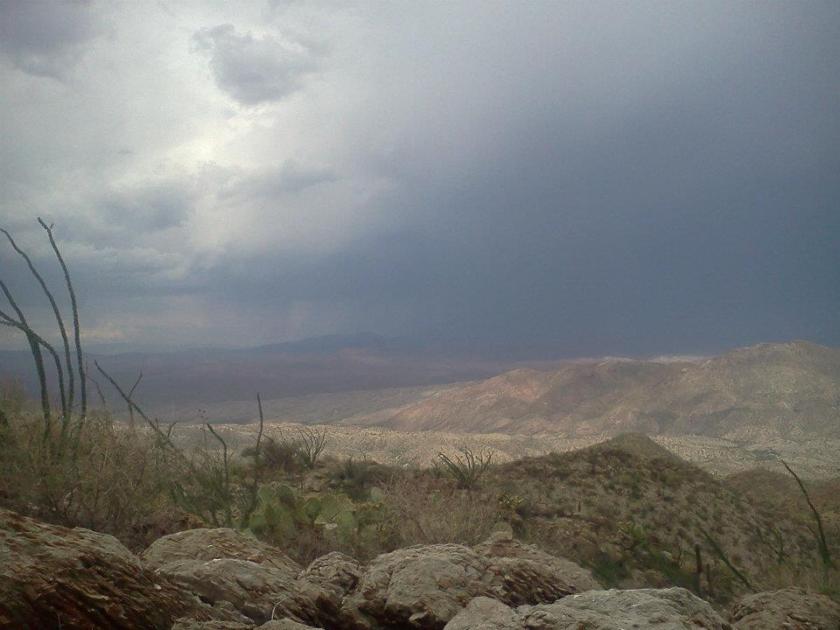
We ran early in the morning like flood waters with sharp teeth and punctual cadence, and we ran fast—wolf fur thick and wavy in the warm desert winds. I had a bottle of water in each hand, mostly for my furry friends whose body temperatures were 3-4 degrees warmer than my own. The sun was milder in the mornings, but the air was still heavy and humid, already anticipating cumulus build-up over the local sky islands—the Santa Catalinas, the Santa Ritas, and the Rincons, to name the closest and largest. The wind rushes over these igneous rock formations (at approximately 10,000 ft.), building pressure systems in a time of year when moisture is spinning counter-clockwise out of the Gulf of Mexico, borrowed from the Tropical Cyclone season in the Caribbean and the heated ocean waters close to the equator. This is the monsoon season of the American Southwest.

My wolves ran beside me as we entered the wash. I had a remote shock collar on Shooter—who listened well unless the call of the wild superseded—mostly for coyotes known to beckon and lure animals to a playful, pack oriented death. Like the gingerbread house in Hansel and Gretel or the clown demon in the rain gutters of the horror movie It, the coyotes lured creatures away with their promise of song and dance. Then the pack closed in and tore the creature limb from limb. Nature is not nice. Nature is to survive and promote genetics.  I had to step in with the threat of handheld lightning in the instance of coyotes with siren-like song that held species survival and murderous intent for anyone less savage than themselves. My wild dogs could probably handle the coyotes, but I wasn’t interested in finding out, only to return with a smaller pack of my own. This would not fare well for our genetics and species survival, either.
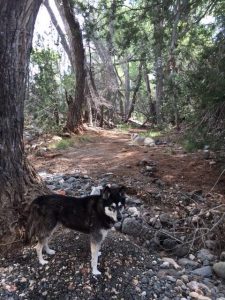
In the lead, Shooter flushed out a rabbit and Rain crept around from the side—as social predators, they began to pursue and hunt as a team. Not truly being hungry, they didn’t catch to kill and eat. They chased and sometimes caught, as a game. And once the animal stopped moving, the game wasn’t fun anymore and they left it. It was clearly all about the chase, as some humans can relate to, as policy and procedure and maintaining interest. On this summer’s day, Rain and Shooter chased a rabbit into the dense, tall growth of weeds and shrubs in the median of the arroyo and disappeared. I didn’t panic. This happened often. I jogged along and looked for an opening or path in the growth, as one usually appeared.

As I already mentioned, there are few large trees in the desert. It’s not like a coniferous forest. And most trees are deciduous. In fact, most of the desert landscapes around the world are quite tree-less. The Sonoran Desert (in Southern Arizona) is lush when compared to other deserts. Arizona contains all four North American deserts – the Sonoran, the Mohave, the Chihuahua, and the Great Basin—and it’s the only state where this occurs. But it’s the Sonoran Desert that allows for certain deciduous, hardwood trees to flourish. The Cottonwood tree is the largest tree in Arizona. So in a state dominated by all four North American deserts, the largest tree to be found is something special. Something unique. As Cottonwoods are a part of the poplar family—closely related to aspen trees—they require more water than a typical desert area might provide. These Cottonwoods must grow close to perennial, intermittent, or ephemeral waterways.

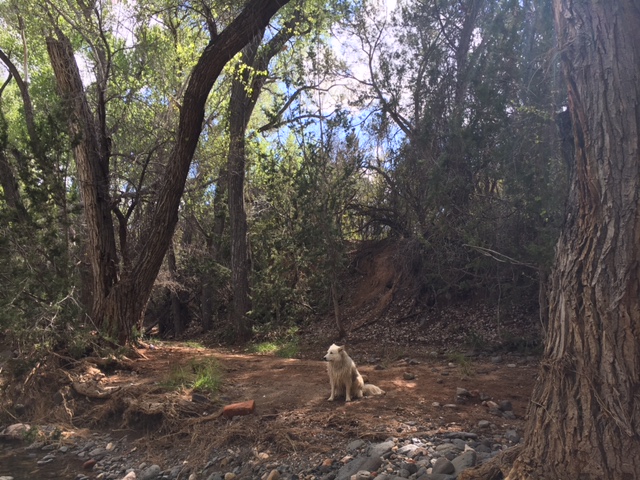
Every once in a while you might find one of these larger trees in the Rillito—a rare instance in which a Cottonwood or a Sycamore took root and shot straight up into the hot, blue sky. Here and now—there and then—I found the infamous Cottonwood tree, it’s large, green leaves whispering and fluttering, light bark beginning to grow thick and knobby around the trunk. To find a Cottonwood tree in the middle of an occasional river bed is truly rare, as most of the desert waterways have been invaded by the Tamarisk, which grows like a weed and monopolizes soil nutrients. Cottonwoods are in direct competition with the Tamarisk. This Cottonwood discovery gives one hope for a healthier desert watershed, as groups of these hardwood trees can be seen clustered together from a distance—a bright splash of green leaves and pale bark in a land of mostly blues and browns—and can always lead you to water in the desert. So the Cottonwood signifies a steady water source, which in turns symbolizes survival in the desert.

I was looking for my animals, but I was drawn to the Cottonwood, mesmerized by the absolute shadow it cast. The tree wasn’t big, maybe 15 feet tall, a young version of its future arboreal splendor. As I walked closer, I could see a lean-to beneath the tree—an empty shopping cart tipped on its side and several pieces of plywood propped against the tree. I immediately felt sorry for the tree, for a live tree is not suited to support human construction and utilitarian burden. Then I noticed the dark boots sticking out of the structure, attached to human legs. A man was laying inside. I stopped fast, scanning for the dogs, not wanting to wake or upset a stranger.

As I spun in circles, the wild pups appeared—over their rabbit hunt—and immediately discovered the motionless man. They were on his doorstep in seconds, sniffing and assessing. They seemed calm, so I strained myself to stay calm, too—a very human endeavor and foreign to most of the animal kingdom. They smelled his legs and torso, then entered the wooden tent and started licking his face—probably for the sweat and delicious oils there. I was nervous, but reacting would alarm the intuitive animals, so I stayed still and watched, ready to act or consider interceding if needed. It happened so fast, there wasn’t much left for me to do, anyway. I was a spectator watching human and animal interaction, praying for the best. Willing a benign encounter, or better.

The man stirred. He had a faded blue baseball cap pulled low, a long-sleeve flannel and torn blue jeans. I called in a hushed voice to Shooter and Rain—“Come here, now!”—but they chose this moment for selective hearing, as the new man in the sand was more interesting and aromatically potent than I was. The man’s eyes fluttered open. He slowly lifted his arm and let Shooter lick his hand. Then he began to scratch the large dog’s chest—Shooter’s favorite place to be pet, other than his hind quarters. Rain, afraid of a fluttering shadow—kept her distance, until she couldn’t stand it anymore. She moved in closer and the man scratched behind her ear—her favorite place to be pet, besides her belly. She remained leery, ready to run at the slightest threat, but she let him touch her which was a sort of desert miracle.

Pretty soon the man was petting the thick, but thinned-out summer coats of both wolfdogs. He sat up, adjusting his cap. I could see his face better. He had a dark beard, and dark brown eyes he kept lowered. He seemed to have an idea of what he was doing.

“Sorry,” I called so he would know I was there and the animals weren’t alone.  I took a few steps closer, but I didn’t want to throw off the balance of animal-human amorous interaction, or send them into guard-the-human-alpha mode.

“I thought the coyotes were finally going to finish me off,” he said. He spoke gently, with a noticeable slur. He probably wasn’t sober, but who knows. I couldn’t make out his ethnicity, as the sun had made him a creature of the desert and he was a brownish-red color. He squinted up at me, then the canines. “These here are really big coyotes. Do you run with them?”

I was holding my breath, I realized, so I let it out and smiled. “Yes, they’re my dogs and we run together.”

The man smirked. “These ain’t dogs.”

I laughed nervously. A tinkling sound like rocks falling in a cave.

“Close enough,” I said. “Ninety-nine point eight percent genetically close enough.”

The man ignored my data touting, staying focused on the animals. “I used to have a dog,” he said. “When I used to have a house.”

I didn’t know what to say to that, so I said nothing. But I knew. My roommate in graduate school digressed from genius to homeless in a matter of days, and there was nothing anyone could do. I know it’s rarely a choice. And it’s usually mental illness. She was schizophrenic and I didn’t even know. Until she stopped taking her meds. That’s when she unraveled and in a matter of weeks, was running barefoot around the university and downtown with the rest of the local, ephemeral population. The descent from normalcy was quick, and if she hadn’t had a family that loved her and friends that cared, she would probably still be there, if not dead. I often think of Rachel when I meet homeless people. I think of her when I start to judge someone—how brilliant the human mind can be, how fragile and fleeting our entire existence. Seeing the world through the eyes of a schizophrenic—danger and death around each jagged, hallucinated corner—made me realize that most homeless people used to have a home. And they probably even used to have a dog. The mentally ill seemed to run in the gap between civilized humanity and the untamed world of wild animals. Like the world of the wolfdog and wild urban landscapes. Like the Rillito River arroyo.

It seemed like I watched for hours as the man pet Shooter and Rain. He stroked them and cooed to them like I wasn’t even there. And incredibly, they stood still and let him. The man was lost in his thoughts, more so with each passing moment. Then, like a gathering desert monsoon, his earth-laden body flooded with emotion and he began to cry. His shoulders shook and tears streamed down his face. Now my Shooter dog is the most sensitive, unruly guardian soul I’ve ever encountered, and human emotion undoes him—the same as thunder. It troubles him to the marrow of his bones. So Shooter whined, in response to the man’s tears, and licked his face with intensity—an act I’d experienced many times myself. Shooter licked his face with so much concern, the man started to laugh, as the wolfdog’s earnestness and empathy forced a crack in the stone wall of human emotion. A life preserver in a sea of black.

Soon the sunbaked man was roiling with laughter, as Shooter’s antics knocked his hat off, and Rain rolled on her back next to him, offering her belly, catching the playful mood and the need for comic relief. This was the first time I’d seen her vulnerable to anyone but me.  The man buried his dark hands in the tangle of Rain’s snow white fur. She wagged her tail and rolled around on her back, smiling upside down with crocodile-like, toothy wit. I’d never seen her do this, but she was enjoying the attention. The man was laugh-crying, so he wiped the moisture from his face, and took deep breaths. As he put his hat back on I could see that it was a faded University of Arizona hat—the red and white “A” now a dark brown. I wondered if he’d been to school, and what sort of events had landed him here, in the bottom of the Rillito River, in the shade of the Cottonwood tree.

With the break in human emotion, Shooter was restless and ready to move on. He was a practical counselor, and not one to dwell in the past. Rain was ready, too. She jumped up and threw herself into Shooter like a tiny wolf wrecking ball, and they were off and running again, kicking up sand in the man’s bed cloths and spinning into the desert wonderland.

The man put his clay hands up in mock protest. He spit sand from his mouth, grinning and shaking his head.

“Sorry about that,” I apologized, feeling self-conscious without the animals.

He slowly wiped sand from his shirt and pants. Then he stared at his palms, face up in his lap for several moments, as if they reminded him of the dogs. He rubbed them together, then, and laced his fingers behind his head. The man was still smiling as he lay back down into the sand. I watched him, wondering if he would respond to me without the animals around.

“Thank you,” he whispered from inside the wooden tent.

I considered thanking him for being so calm. For his willingness to interact with the unknown. For playing a symbiotic role in the rehabbing of Rain. But I didn’t.

“You’re welcome,” was all I said.

I followed in the wake of my ambassadors.  As we ran in the raised center of the wash, away from the only Cottonwood tree in the Rillito River for miles, I could already see the cumulus clouds building over the Catalina Mountains. The relative humidity was on the rise and the air temperature would rise with it. Until it began to rain. I watched the fluffy tails of my wolfdogs disappear into tamarisk and willow scrub ahead of me and I couldn’t help but wonder if our new sand man friend would find his way out of the arroyo before the big floods came. I couldn’t help thinking that if he didn’t, at least he would sink beneath the water with a smile on his face.